
Criminal Court Records in Garvin County
A criminal court record is the case file the Court Clerk opens once formal charges are filed against a person. It is not the same as an arrest report or a jail booking. The file begins when the prosecutor files a charging document and stays open through every hearing, plea, and order until the case closes. The Court Clerk's criminal division keeps the master record, indexes it by case number, and posts most of its docket entries to Oklahoma's public court systems. For a closer look at the accusations themselves, see the Garvin County arrest records and court charges page.
Garvin County criminal cases are heard in the District Court, the state's general trial court. The District Court handles both felony matters, filed under a CF case prefix, and misdemeanor matters, filed under a CM prefix. Municipal courts in Pauls Valley and Lindsay handle city ordinance and many traffic violations, but those are separate from the District Court criminal file. The District Attorney for District 21, which covers Garvin, Cleveland, and McClain counties, files the formal charges that open each case.
The charging document is called the Information. The District Attorney's office prepares and files it, and the named prosecutor leading District 21 is Jennifer Austin. You can read more about the office on the Oklahoma District Attorneys Council District 21 page.
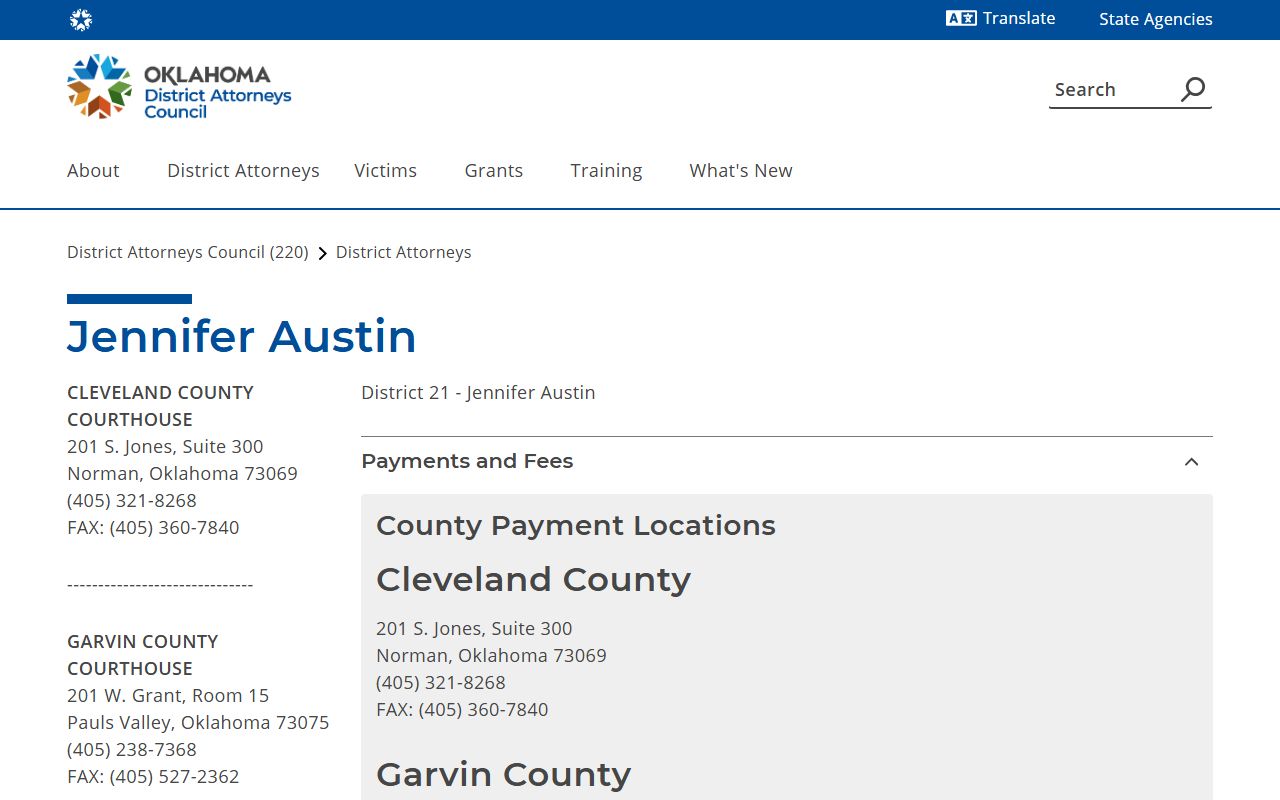
Once the Information is filed, the charges and every amendment to them become part of the public District Court file. The prosecutor can add counts, reduce a felony to a misdemeanor, or dismiss a charge, and each change is logged on the docket.
How to Search Garvin County Criminal Court Records
The main case search runs through the Oklahoma State Courts Network, known as OSCN. Its docket page covers Garvin County District Court and lets you look up a case by number or search by party name. A second statewide system, On Demand Court Records, or ODCR, also indexes Garvin County and adds flexible name and case-type filters.
- Open the OSCN docket search and choose Garvin County District Court from the court dropdown.
- Search by the defendant's last and first name, or enter a known case number such as CF-2014-1.
- Narrow the results by case type, choosing Criminal Felony or Criminal Misdemeanor, and by filing date range.
- Open the matching case to read the full docket, the charges, hearing dates, and the disposition.
- Request a certified copy from the Court Clerk if you need an official version for legal use.
If a name search returns nothing on OSCN, try ODCR with the court group set to Oklahoma District Courts and the court set to Garvin. Statewide criminal history is a separate channel handled by the Oklahoma State Bureau of Investigation, not the court clerk. For records that are sealed, very old, or not yet imaged online, the Court Clerk counter at the courthouse remains the fallback.
Stages of a Garvin County Criminal Case
A criminal case moves through a fixed set of stages, and each one leaves a mark on the court record. Reading a docket is easier when you know which event belongs to which stage. The flow below tracks a case from the day charges are filed to the day a sentence is entered.
Case flow: Charges Filed › Arraignment › Pretrial / Motions › Plea or Trial › Disposition › Sentencing
| Stage | What Happens |
|---|---|
| Arraignment | The defendant appears, hears the charges from the Information, and enters a plea of guilty, not guilty, or no contest. |
| Pretrial / Motions | Lawyers exchange evidence, file motions to suppress or dismiss, set bond conditions, and discuss plea offers. |
| Plea or Trial | Most cases end in a negotiated plea; the rest go to a judge or jury who decides guilt on each count. |
| Sentencing | The judge sets the penalty, which may include jail, prison, fines, costs, probation, or a deferred sentence. |
Defendants who cannot afford a lawyer may be appointed counsel through the Oklahoma Indigent Defense System. Garvin County is served by the Cleveland Regional Non-Capital Trial Office, described on the Oklahoma Indigent Defense System Garvin County page.
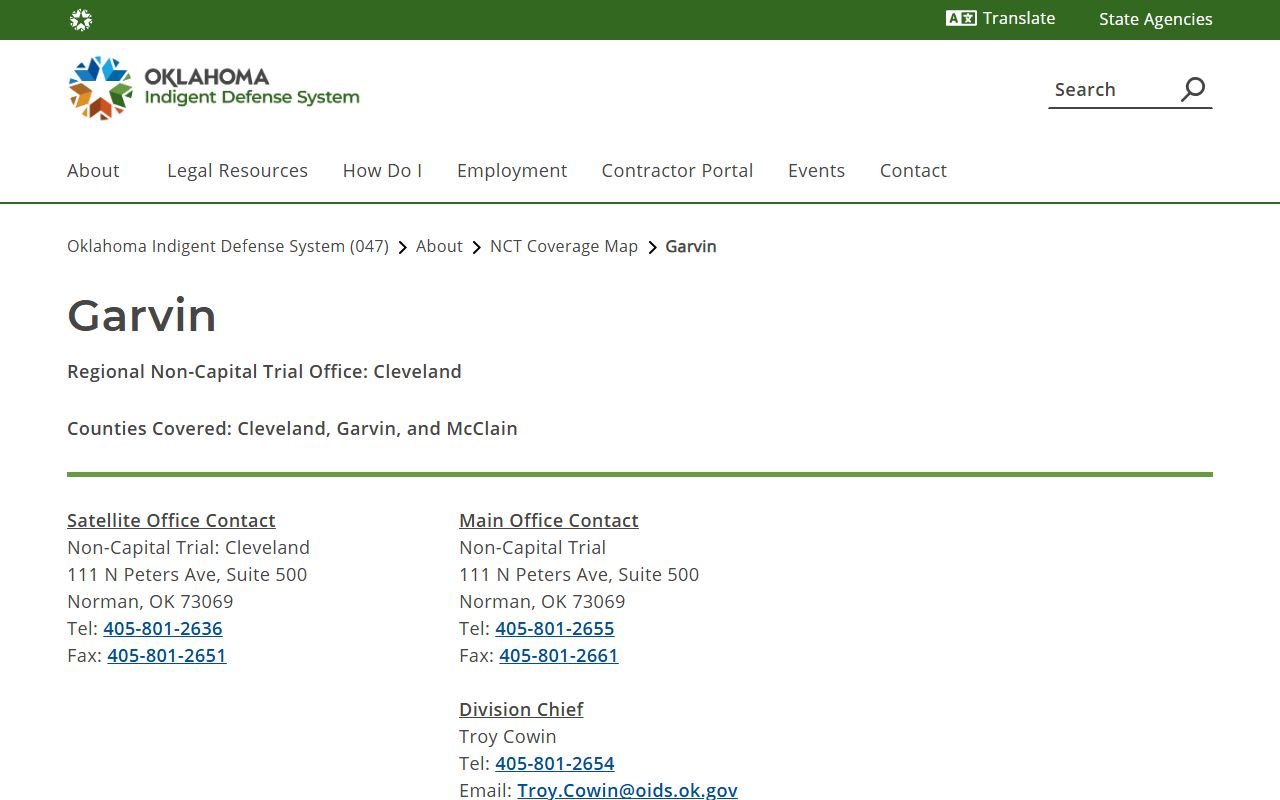
That appointed-counsel office sits in Norman and covers the wider judicial region, so the assigned attorney often handles appearances across multiple counties. The docket usually names the attorney of record once one is appointed or retained.
Note: A continuance entry on the docket only postpones a hearing and does not change the charges, the plea, or the final disposition of the case.
What a Garvin County Criminal Court Record Shows
A criminal case file is built from many fields, and each one answers a different question about the case. The docket lists events in date order, while the case header carries the identifying details. The table below breaks down the core fields you will read in a Garvin County District Court criminal record.
| Field | What It Shows |
|---|---|
| Case Number | Prefix, year, and sequence such as CF-2014-1, where CF marks a felony and CM a misdemeanor. |
| Defendant | The name of the person charged, listed opposite the State of Oklahoma as the prosecuting party. |
| Charges | Each count filed by the District Attorney, plus any amended, reduced, added, or dropped charge. |
| Plea | The defendant's formal answer to each count, entered at or after arraignment. |
| Disposition | The outcome of each charge, such as guilty, dismissed, acquitted, or deferred. |
| Sentence | The penalty imposed after a conviction, including custody time, fines, costs, and probation terms. |
Financial entries also appear in the file. These include bond amounts, court costs, fines, and restitution ordered for a victim. Document images may be paywalled, attorney-restricted, or simply not scanned, even when the docket text describing them is visible. Personal identifiers such as Social Security numbers and confidential addresses are redacted from public view.
Charges vs. Convictions
Being charged is not the same as being convicted. A criminal court record can show counts that were later dropped, dismissed, or that ended in an acquittal at trial. A charge is only an accusation, and the file may carry several charges that never led to a finding of guilt. Reading the disposition for each count, not just the opening charges, is the only way to know the real outcome.
| Charge | Conviction | |
|---|---|---|
| Stage | Accusation | Verdict or plea |
| Burden of Proof | Probable cause | Beyond reasonable doubt |
| Public Record | Yes | Yes |
Both charges and convictions sit in the public file, which is why careful reading matters so much. A person can carry a dismissed felony charge on the docket and still have no conviction at all. The Garvin County court records system keeps the full history visible so the difference is never lost.
Reading Garvin County Dispositions and Sentences
The disposition is the field that tells you how a charge ended. Common entries include guilty, not guilty, dismissed, nolo contendere, which means no contest, and deferred. A deferred sentence places the defendant on supervision, and if the terms are met the case may be dismissed later. The sentence line then spells out the penalty, listing any custody time, the fine and cost totals, and the length and conditions of probation.
Statewide criminal history through the Oklahoma State Bureau of Investigation compiles dispositions from across the state into one report. The OSBI Criminal History Information Request Portal, or CHIRP, runs name-based searches that pull these outcomes together.
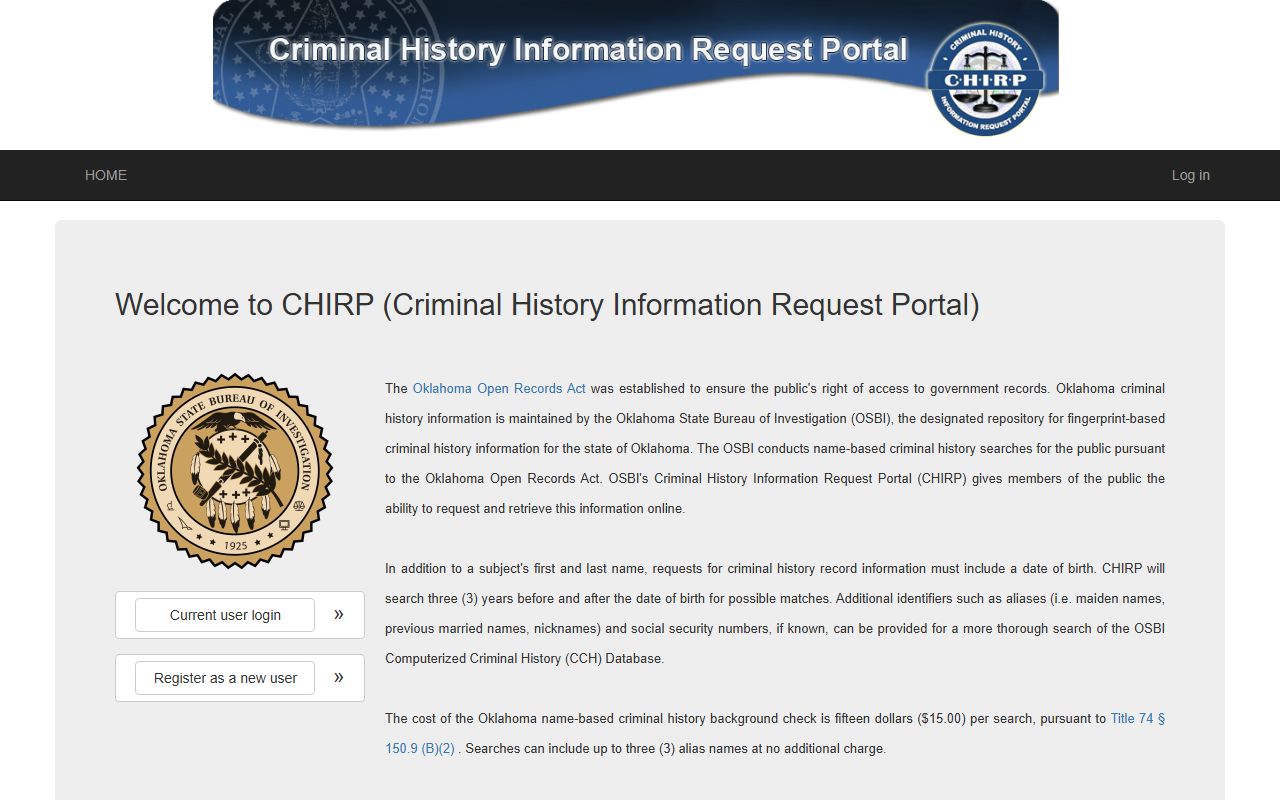
A CHIRP report is not a live court docket and is not a warrant search, so it works best as a summary rather than the official case file. When you need the exact disposition for a legal purpose, the certified court record from the Court Clerk is the controlling document.
Note: A deferred sentence is not the same as a dismissal at filing, because the charge stays on the docket until the supervision period is finished and the court enters the result.
Sealed vs. Expunged Records
Oklahoma law treats sealing and expungement as two different remedies, and the OSBI handles both. Under 22 O.S. Section 18, an eligible person can expunge an entire arrest record, which removes it from public access. A separate path under Section 991(c) applies to a deferred sentence and changes the court disposition to show a not-guilty plea and a dismissed case, but it does not remove the underlying arrest record.
| Sealed | Expunged | |
|---|---|---|
| Visibility | Hidden from public | Treated as if it never existed |
| Law Enforcement | Limited access | Very limited access |
| Eligibility | Deferred sentences updated under Section 991(c) | Qualifying arrests cleared under 22 O.S. Section 18 |
Cost separates the two requests. Expunging a court record is free, while expunging an arrest record requires a $150 OSBI processing fee paid by cashier's check or money order, since personal checks are not accepted. The OSBI criminal history record expungement page lists the full process and the information the petition must include.
The petition should give the OSBI the person's name, Social Security number, date of birth, the crimes charged, the arrest date, and the court disposition. Domestic-related matters may need a police narrative to avoid delay.
Public Access to Garvin County Criminal Records
Criminal case files are public records in Oklahoma, which is why most dockets appear on OSCN and ODCR without a login. The Oklahoma Open Records Act sets the framework. Public bodies must keep records open unless another statute makes them confidential, and court files fall under that broad presumption of access along with the courts' own rules.
Key Statutes:
Oklahoma Code § 51-24A.5 - Public records stay open for inspection unless another law makes the record confidential.
Oklahoma Code § 51-24A.8 - Sets which law enforcement records the public may inspect and which may be withheld.
Access is broad but not absolute. When a record is not online, the next step is the office that created it. The Court Clerk holds District Court files, and certified copies are requested at the courthouse counter or by calling the clerk directly.
Background Check Considerations
A casual docket search is not the same as a regulated background check. Employers, landlords, and lenders that use criminal history for hiring or screening must follow the federal Fair Credit Reporting Act and use a licensed consumer reporting agency. For a personal or formal background report, the OSBI is the official Oklahoma source, and it requires a full name and date of birth.
The bureau accepts requests by mail, fax, in person, and online through CHIRP. The OSBI background check request page lists the required identifiers, the accepted channels, and the current fees.
That official report carries more weight than a raw docket printout because it standardizes the format and the identifiers. For sentenced offenders sent to state prison, the Oklahoma Department of Corrections offender lookup tracks custody after a person leaves the county jail.
Important: This website is not a consumer reporting agency under the FCRA, and its information may not be used for employment, tenant, credit, or insurance screening decisions.
Restricted Criminal Court Records in Garvin County
Some criminal records are kept out of public view by law. Juvenile cases are generally confidential under 10A O.S. Section 1-6-102 and should not be treated as ordinary public dockets. Sealed and expunged matters drop out of the public systems entirely, so a search may return nothing even when a case once existed. Adoption files and mental health proceedings are also confidential or heavily restricted.
Open investigations add another limit. A sheriff's jail list entry can appear before any case is filed, and the full District Court record only opens once the District Attorney files the Information. Until then, details may be thin and warrant information may stay private. The Garvin County jail roster is a separate list from the court file, so a name on the roster does not always match a public case number yet.
Note: A blank search result is not proof that no record exists, because sealed, juvenile, or unfiled matters are deliberately hidden from the public docket systems.